
XO3D Studio · Industry
Product CGI for Gaming & Esports Brands.
XO3D works in a category defined by precision detail, RGB rendering, and a community of buyers who will immediately identify imagery that doesn't respect the product.
Gaming and esports peripheral CGI has a specific challenge: the audience. The buyers of high-end gaming keyboards, mice, headsets, and controllers are among the most visually literate product consumers in any category. They know exactly what a Cherry MX switch looks like. They'll notice if the stabiliser wires under a spacebar are rendered incorrectly. They can identify a generic metallic shader applied to a frame that should be brushed aluminium. Getting the detail wrong doesn't just make the imagery less impressive, it actively signals that the brand doesn't understand its own product.
XO3D has made launch films and renders for two G-Lab keyboards: the Keyz Hydrogen, a compact 60% board, and the Keyz Titanium. Each brief turned on a different creative decision, set out below.
Explore the product CGI stills and product CGI films services that underpin our gaming work.

The category challenge
Why gaming CGI demands a specialist approach.
Light that behaves correctly
RGB per-key lighting on a gaming keyboard isn't a single colour property, it's a complex interaction between LED intensity, keycap translucency, switch housing colour, and the amount of light that bleeds onto the surrounding surface. The lighting treatment is decided per product and agreed with the client, so the glow reads as the product's own rather than a generic effect.
Switch, stabiliser, keycap, all visible
Gaming peripherals are designed to be examined closely. The switch mechanism under the keycap, the stabiliser on a spacebar, the texture moulded into a mouse button, all of these can be visible in product imagery and are looked at closely. The model is built to the detail the agreed views need, so the parts the camera sees close up are modelled for that distance.
The difference between gaming and premium
Gaming peripheral brands are increasingly competing on premium material quality, aircraft-grade aluminium frames, textured rubber grips, precision-machined components. The CGI must communicate this material investment accurately. A brushed aluminium frame that reads as plastic undermines the product's premium positioning immediately.
An audience that knows the product
Gaming peripheral buyers research extensively before purchasing, they know the spec sheets, the teardown videos, the community reviews. CGI that misrepresents product dimensions, switch types, or material finishes will be identified and called out. Accuracy is not optional in this category.
Featured work
Two keyboard launches, two creative decisions.
Show a compact board and its colours.
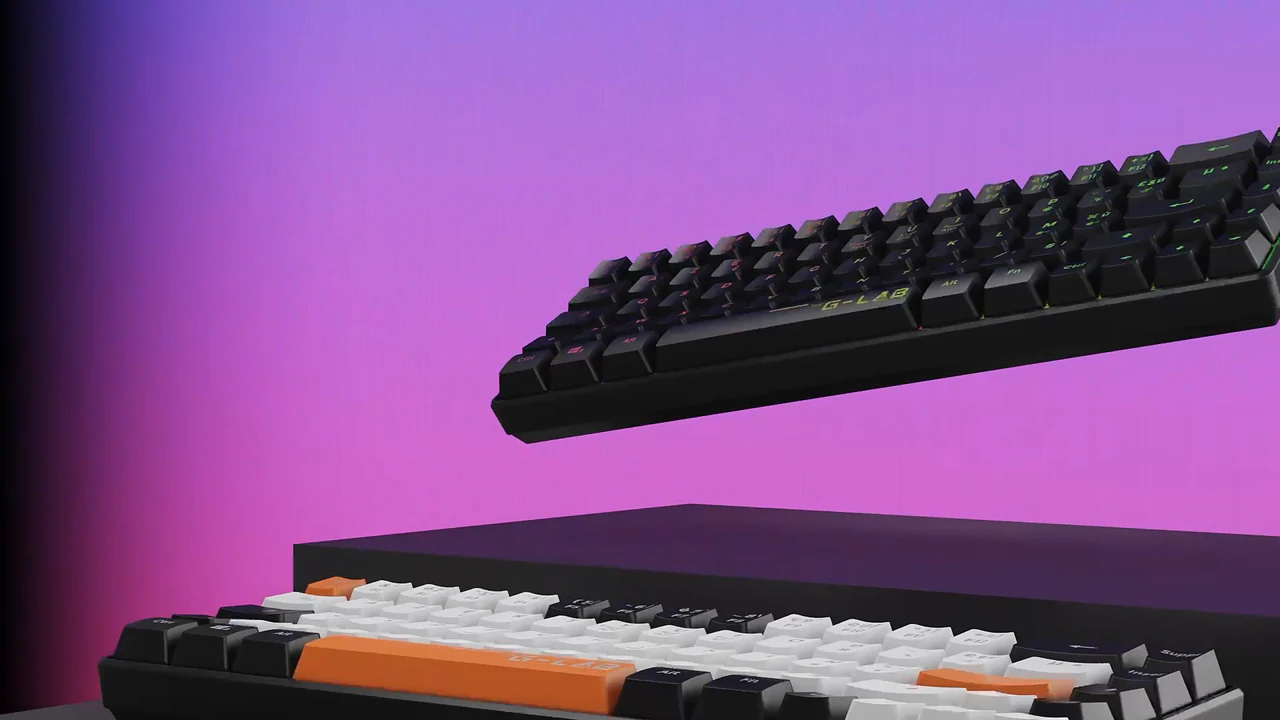
The Keyz Hydrogen is a compact 60% keyboard, and G-Lab needed one launch piece that covered its features and colour options. The decision was to make the size and the colourways readable at a glance: a size-comparison sequence floats the board above a full-size outline, a colour-flick montage moves through the finishes, and close-ups show the keys, the logo and the backlighting.
Lock the film to a tempo first.
For the Keyz Titanium, the decision was to build the film around a base tempo guide from the start, so camera moves, transitions and key beats followed one rhythm. Every shot was reviewed in greycard against that guide before final lighting and RGB went in. The result is a 35-second film with renders of the board in several wired colourways.
Read the Keyz Titanium case study · Watch the Keyz Titanium film
In the detail
Show the detail that distinguishes this product.
A peripheral launch is judged up close. Decide which detail makes this product different, then give that detail its own shot: the construction around a key, the footprint of a compact board, the way the backlighting reads, or the finish on the frame. The four frames below come from the two G-Lab projects. Each label names what the frame shows. None of them identifies a switch brand, and the colours are approved render treatments rather than a promise of how they will look on every screen.
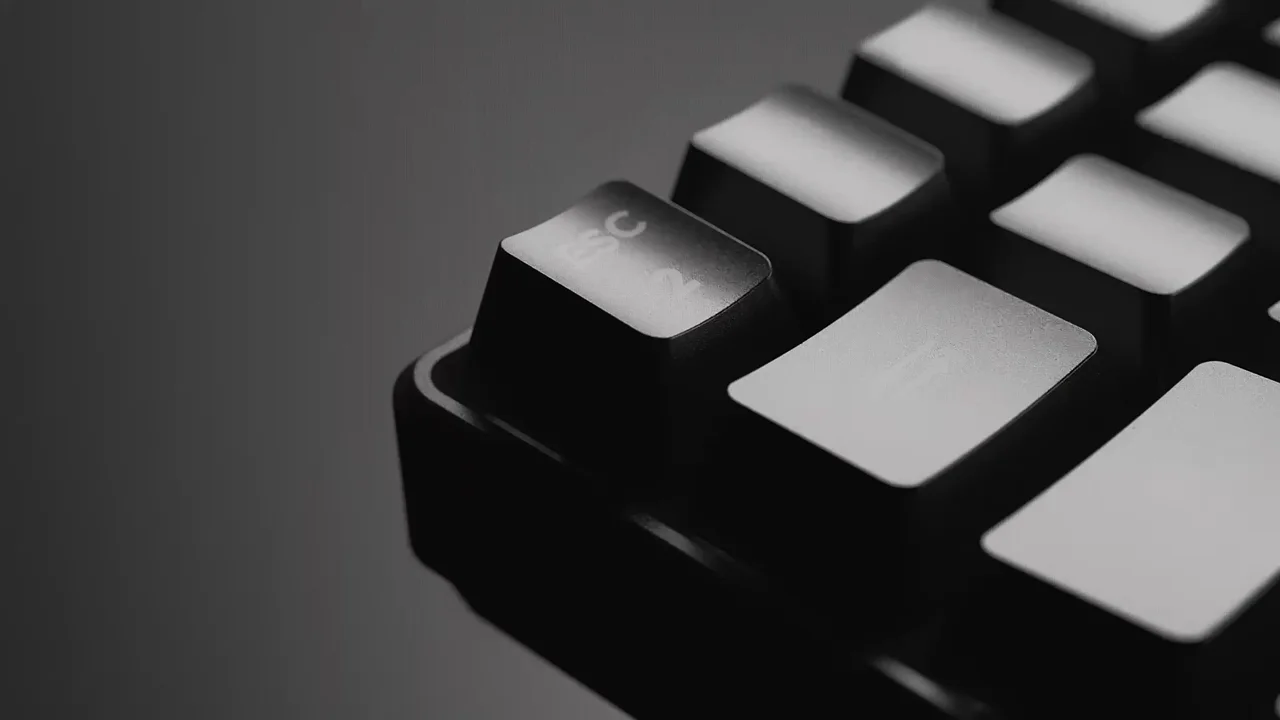
Construction. Keyz Hydrogen: the Esc key and its neighbours in close-up, the opening frame of the escape-key sequence. 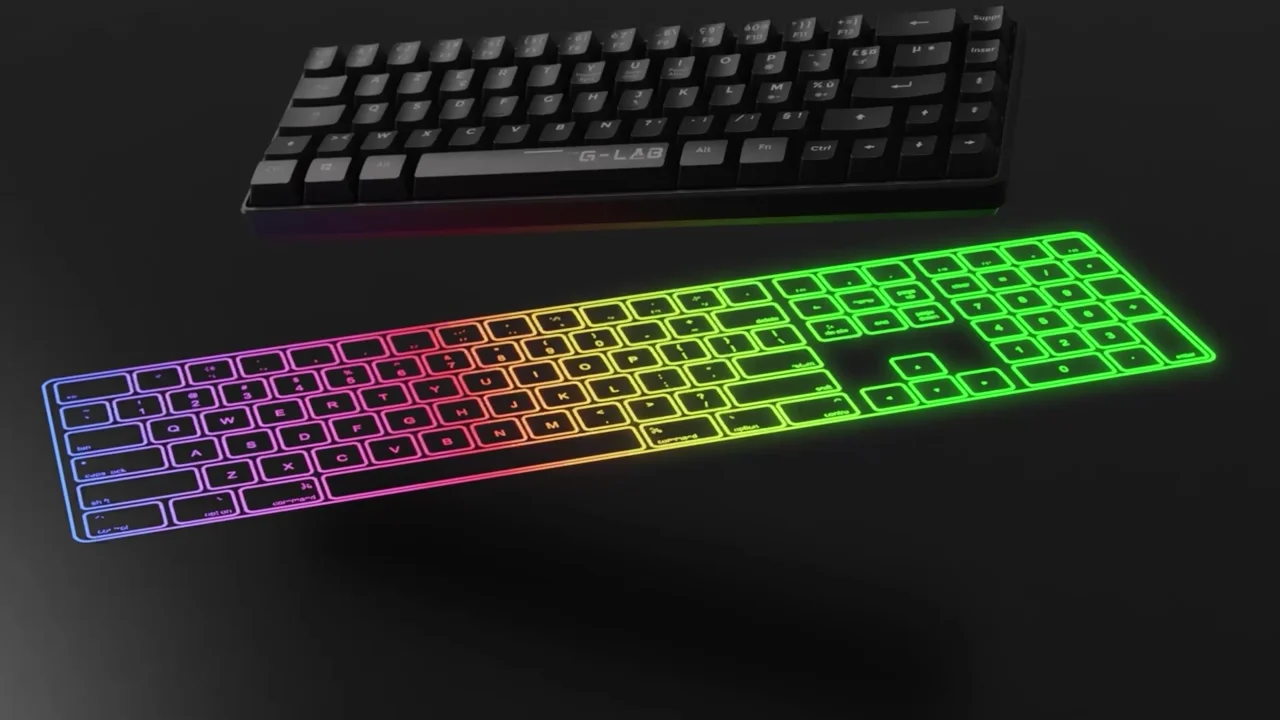
Form. Keyz Hydrogen: the compact 60% board above a glowing full-size outline, so the footprint reads without a measurement. 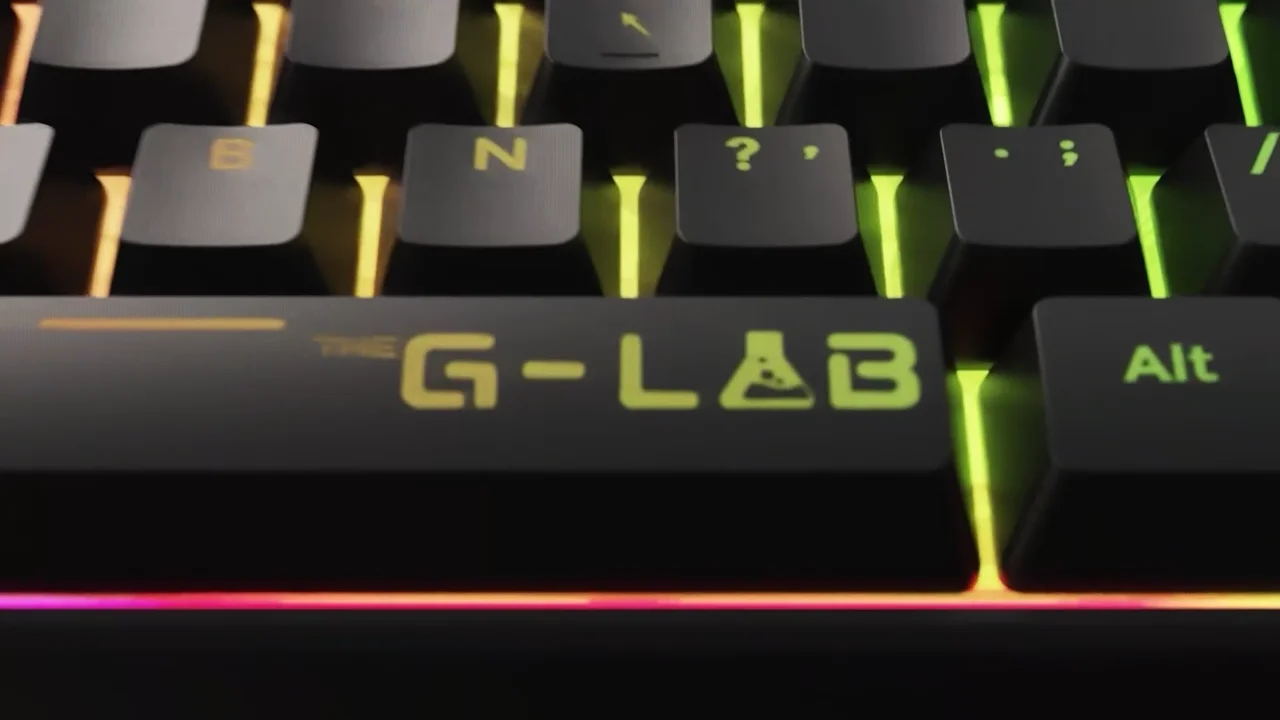
Lighting. Keyz Hydrogen: coloured backlighting along the key edges and around the G-Lab logo. 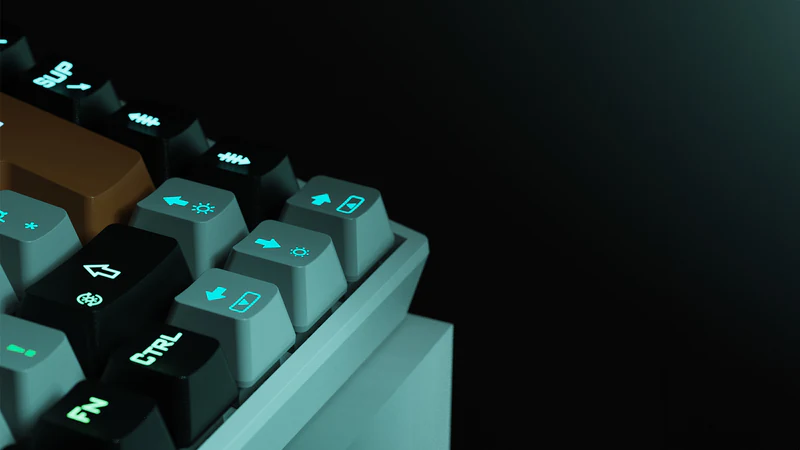
Finish. Keyz Titanium: the corner of the board, showing keycaps, lit legends and the frame edge.
What we produce
For gaming and esports peripheral brands.
Keyboards and mice are published XO3D work. Headsets, controllers and mousepads are brief types we can assess, without a published project to show yet.
Full board to key detail
Launch films, hero renders, backlighting detail, macro keycap close-ups, an exploded escape-key sequence and colourway sets, as made for the G-Lab Keyz Hydrogen and Keyz Titanium.
Form, texture, detail
Product renders in several finishes, a seamless 360 and short animations of details such as the scroll wheel, as made for the Bluestork ergonomic mouse.
Assessed per brief
XO3D has no published headset or controller case study. A brief for one is assessed on its source files, finishes, lighting modes and the outputs needed.
Assessed per brief
Surface-texture close-ups for mousepads, wrist rests and accessories are a brief type we can assess. There is no published XO3D project for them yet.
Cuts from one build
Launch films, feature close-up cuts and platform-format cut-downs from one build, as on both G-Lab keyboards.
Listing imagery
White-background packshots, multi-angle views and colourway sets from the same 3D build as the campaign imagery. Each marketplace's current image rules are checked for the listing in question.
Before you brief
What to send for a peripheral launch.
A short list saves a round of questions. Send what you have; an NDA can be agreed before any technical files change hands.
- The latest CAD or drawings, and the revision they show.
- The switch and keycap revision the product uses.
- The approved key legends.
- A finish reference for each colourway.
- The lighting modes the product is allowed to show.
- The variants: wired, wireless or both.
- The brand direction, and which feature should lead.
- The outputs you need, and where the launch cuts will appear.
- Who approves the product details.
To prepare engineering source for CGI or agree product truth before production, use our guides. To plan a directed product film, start with the film. A full launch visual suite covers film, stills and channel cuts from one build, and a visual content partnership suits ongoing content after launch. Tell us which feature leads and which modes are approved, or set the brief out with the CGI brief template.
FAQ
Gaming CGI questions.
Can you accurately render individual switch types (Cherry MX, Gateron, etc.)?
How do you handle RGB lighting across different colour zones?
Do you work with pre-production gaming peripherals from engineering files?
Your next project
Show the hardware in action.
Choose the controls, lighting or construction details that distinguish the product. Build the sequence around those features rather than a list of specifications.
A route to consider
Product CGI Films
A product film developed through creative treatment, storyboard, animatic, product review and final picture and sound.
Bring these three things.
- Which feature should lead the film?
- Which lighting modes and variants are approved?
- Where will launch cuts appear?
Start with an outline. We review the product, intended outputs and timing before agreeing the production scope.