
Service
Exploded view and cutaway animation.
XO3D is a director-led product CGI studio in Stevenage, UK. We make exploded view and cutaway animation from your CAD for engineered products, so buyers can see how the product goes together and what is inside it.
Tell us about your briefSelected clients








Sony work via ImageNova. Ferrari and Burberry work via KCD.
Take the product apart on screen, in an order that explains it.
An exploded view animation separates a product into its components so a viewer can see how it goes together. A cutaway, or cross-section reveal, opens the product up to show its internal detail. XO3D builds both from your CAD, and directs the order, pace and camera so the sequence explains the product rather than only decorating it.
The work is for product marketing, sales and engineering teams whose product has value that photography cannot show: a locking mechanism, a replaceable part, a circuit board, a fire-suppression nozzle. A camera cannot open a product up without physical modification. CGI can, from the same 3D build that drives the launch film and the stills.
Below is real exploded work from XO3D projects, what we need from you, how a sequence is directed and what you receive. This page is for commissioning. The guides linked further down explain the technique.
What we deliver
Scope the right outputs.
Squire Locks Inigma and Boron.
Two exploded animations built around the internal locking mechanism. The order in which the parts separate was built from Squire's engineering data, not arranged for looks alone. Read the Squire Locks case study.
Plumis Automist nozzle.
An exploded technical animation of the Automist nozzle, with every component sequenced and labelled. Made for the website, social channels and trade-show loops, so specifiers and prospects can grasp the engineering at a glance. Read the Plumis case study.
Duux Neo, repairability made visible.
Duux designed the Neo so the user can replace the ultrasonic element with a simple twist. The exploded animation turned that engineering intent into a clear product-page visual, with exploded stills from the same CGI source. Read the Duux case study.
Flash Motors Infinity X controller.
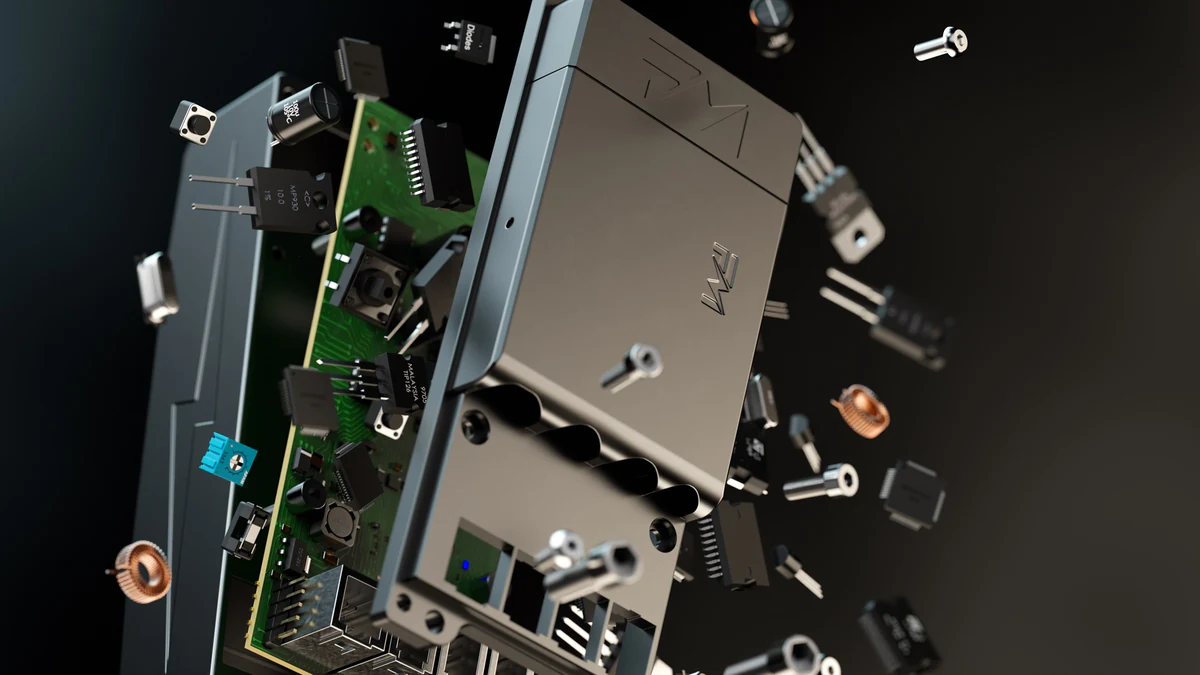
Three exploded-view animations take the controller apart into its housing, circuit board and assembly components, with exploded stills from the same 3D build for the product page and trade marketing. Read the Flash Motors controller case study.
Cutaway and cross-section reveals.
A cross-section reveal of a pedestal fan, combining a section through the product with an exploded view so internal detail shows as parts separate. A cutaway is built from the same 3D asset as an exploded view. See the exploded animations guide.
Who commissions it
Teams explaining a product that cannot be opened up.
Product marketing, sales and engineering communication teams at brands where the value sits inside the product. Recent XO3D projects cover security hardware, fire suppression, home appliances, e-mobility electronics, portable coffee machines and modular products.
Agencies and in-house teams both commission it. XO3D made the Squire Locks films with Curious Agency.
Process
Our exploded view and cutaway animation process.
- 01
Agree the part order.
Which parts separate, which stay assembled, in what order and at what pace. The order comes from your engineering data and is agreed with your product team before animation starts.
- 02
Build the hierarchy.
The 3D asset is structured for component-level movement, and every part is modelled to close-view quality because an exploded view shows each one up close.
- 03
Review in greycard.
Part movement, geometry intersections, timing and framing are checked before materials and lighting. The greycards go to your team for approval before the work moves on.
- 04
Direct, finish and cut down.
Cameras follow the separation and reveal key components at key moments, with labels where the audience needs named parts. The master is finished, then cut for short-form social and a silent product-page loop.
Why XO3D
What makes an exploded sequence credible.
Sequence from engineering data.
The part order for the Squire Locks films was built from Squire's engineering data, not arranged for looks alone.
Reviewed with your team.
On Nanuskate, every assembly step was reviewed in greycard with the client to confirm the order of parts, motion timing and connection logic.
One build, every output.
The Flash Motors controller and the Duux Neo each carry animation and exploded stills made from one 3D build, so film and stills stay consistent.
A director behind every brief.
A named creative director stays accountable for the camera, timing and finish, from the first reference to the final grade.
What to send us
Exploded and cutaway work starts from your 3D source. Send what you have, and we confirm compatibility with the actual files, and any conversion or remodelling, at intake.
| Source | What it gives us |
|---|---|
| STEP (.stp, .step) | The safest default for CAD. Preserves geometry and assembly structure. |
| Native SolidWorks, Rhino or Inventor files | Preserve more than STEP. SolidWorks files keep the full assembly hierarchy and material assignments. |
| IGES (.igs, .iges) | A common alternative to STEP, workable in most production pipelines. |
| FBX or OBJ | For a product that exists only as a mesh. Easiest for our team to work with, and portable between applications. |
| Drawings, finish and material references, physical samples | Used alongside CAD. A mesh, scan, drawings or photographs can also be a starting point. |
Say which components must stay separate before the source geometry is simplified. Supplied CAD is rarely the final render-ready model, so most projects involve some remodelling, and every part of an exploded view is seen close up. The production specifications set out the standards in full.
What you receive
- Exploded view animation. The hero sequence, in the order and at the pace agreed in greycard. A hero exploded shot typically runs 6 to 15 seconds, and sequential-build or labelled versions run longer.
- Cutaway or cross-section reveal. Interior detail shown as a section through the product, or combined with an exploded view as parts separate.
- Labelled technical sequence. On-screen labels that call out named components, as on the Plumis Automist nozzle.
- Exploded and cutaway stills. Technical frames that expose components, assembly logic and internal systems, rendered from the same scene. The Squire Locks exploded render was made for print, trade catalogues and dealer materials.
- Cut-downs. Short-form edits for social, and a silent loop for the product page.
- Film and still files. Films at 24 frames per second and Full HD as standard, with 4K on request, as ProRes or H.264. Stills as PNG or JPEG at around 4,000 pixels on the long edge for digital use, with larger print sizes agreed at brief.
A technical or mechanism film typically takes 5 to 9 weeks. That is a working range, not a delivery promise. Where a project sits in it depends on the CAD, materials and finishes at kickoff, and review stages and approval owners are agreed before production begins.
More exploded and assembly work
- Caffe2go Presso XI: an exploded animation that pulls the machine apart to show the heating plate, temperature sensors and internal architecture, built with Caffe2go engineering.
- Nanuskate modular skate ramp: exploded and step-by-step motion that shows how the components align, lock and extend.
- G-Lab Keyz Hydrogen: an exploded escape-key sequence inside the 40-second launch film.
- Allwood Joinery Modulite: exploded and disassembly views alongside a step-by-step assembly explainer.
- VivaCity AI traffic sensors: exploded views and product demo sequences in an explainer that runs 1 minute 13 seconds.
- In the video gallery, watch the exploded films for Squire Locks Inigma and the Duux Neo.
Read the explainers
This page is for commissioning an exploded view or cutaway animation. The guides explain the technique: exploded views covers the still, and exploded animations covers the animation, including cross-section reveals.
For the wider engineering brief, see Technical CGI. For a film that carries an exploded sequence inside a launch story, see product launch films. The CGI studio briefing guide sets out what a brief should contain.
FAQ
Common questions, answered.
What does an exploded view animation company make?
What is a cutaway animation, and how does it differ from an exploded view?
What files do you need for an exploded view animation?
Can an exploded view show the internal parts accurately?
Can you make an exploded view animation before the product is manufactured?
How long is an exploded view animation, and what do you deliver?
Should we commission an exploded view animation or a product launch film?
Other product services
There's more.
Start the conversation
Have a product worth taking apart?
Send the files, the audience and the date. We reply to every brief personally, usually within one working day.
About the studio
XO3D is a director-led product CGI studio. Founded by Thomas Howcroft in 2017 and incorporated as XO3D Ltd (UK Companies House 11876020) in 2019, when Alex Mann joined as co-founder. Based at the Business and Technology Centre in Stevenage, UK, with representation at 244 Fifth Avenue, New York. We work with tech, industrial and premium consumer brands on product films, launch stills and interactive experiences.